
Mission Control Culture
Atomic Fireballs
Mission Control's Sweetest Tradition
For decades, a simple cinnamon candy became one of the most recognizable traditions within NASA's Mission Control Center. What began as a gesture from a support engineer eventually became part of the culture of Shuttle-era Flight Dynamics Officers.
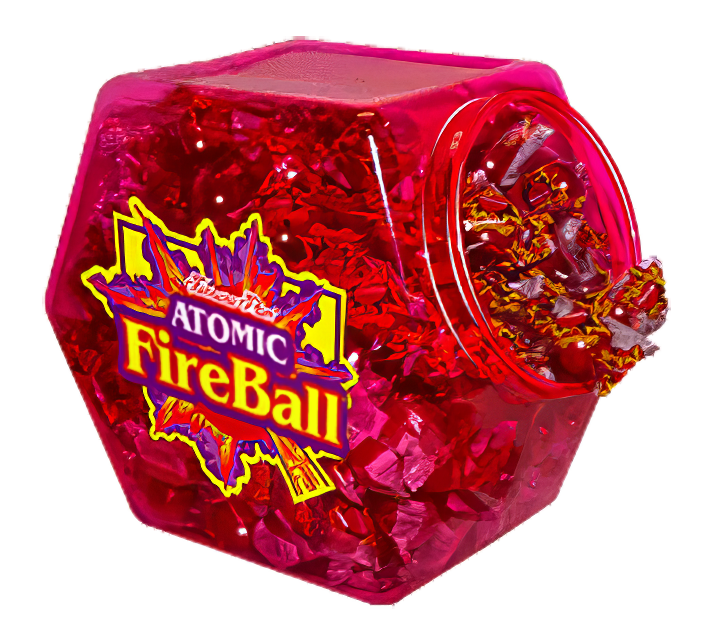
There are thousands of items that have passed through NASA's Mission Control Center over the decades.
Foam cups, flight plans, trajectory printouts, cold pizza at 3am, the occasional lucky charm tucked into a pocket.
Most of them disappeared without ceremony.
One did not.
What Were Atomic Fireballs?
To an outsider, they were simply cinnamon candies.
To generations of Flight Dynamics Officers and the rest of the Flight Control teams, they were a fixture of Mission Control. Atomic Fireballs appeared on console during launches, landings, satellite deployments, rendezvous operations, and countless overnight shifts.
Like many traditions, nobody formally required them. They simply became part of the room.
In the beginning
The tradition begins around STS-26, the Return to Flight mission in September 1988. It traces back to Karen, a member of the Mission Control reproduction team.
Her job was to support Flight Controllers with the enormous volume of flight documentation that kept Shuttle operations running. Karen had a personality to match her surroundings. And she had a thing for Atomic Fireballs.
When she would make her rounds, she started bringing Fireballs along and became the unofficial supplier of this spicy candy to the Flight Dynamics Console. FDOs soon discovered that a Fireball at 2am was exactly what a flagging shift needed.
The deliveries became expected.
Then legendary.
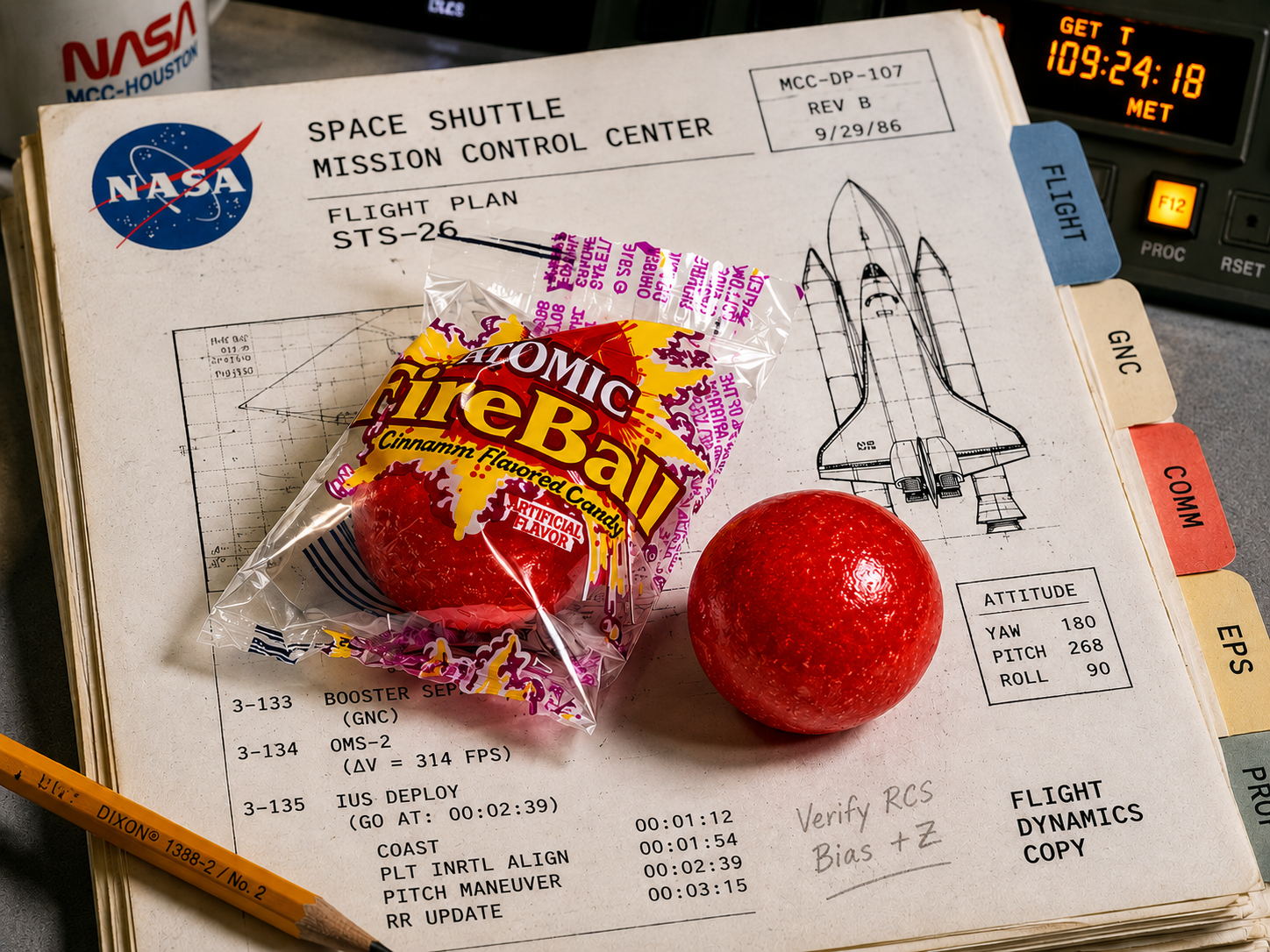
Born in 1954. Still going strong.
Nello Ferrara created the Atomic Fireball using the "hot panned" process: layers of flavor and color built onto a single grain of sugar in a revolving pan. Spicy, sweet, and relentless.
Within three weeks of sending samples to brokers, orders were arriving at more than 50,000 cases per day. A candy with production capacity of 200 cases per day. The math did not work in anyone's favor.
A Console Tradition
Fireballs Created
Nello Ferrara develops the candy that is an immediate runaway success.
Karen from Repro
Fireballs first appear in the MCC, distributed informally.
It's Official
The Orbit 1 FDO delivers the first full box to the MCC.
Fireballs in Space
Astronaut Susan Helms carries a single Fireball on STS-64 in tribute to The Trench.
The Last Mission
Atlantis lands. The Shuttle Program ends. The FDO position is retired.
For All Mankind
Fireballs and the Flight Dynamics Officer are together again in the alternative universe.
The Box Returns
With the FDO position formally restored for the Artemis program, the Fireballs are back.
Why FDOs?
The Flight Dynamics console simply became associated with the candy.
Perhaps it was because FDOs worked some of the most demanding shifts.
Perhaps it was because the cinnamon kick helped during late-night operations.
Or perhaps... traditions simply find a home.
New FDOs inherited the tradition along with the procedures, tools, and responsibilities of the position.
The FDO Console Handbook
In a development that still delights anyone who remembers it, the Atomic Fireball earned a place in the Lead FDO Console Handbook. The procedures document for one of the most technically-demanding positions in human spaceflight includes a formal passage on the history and responsibility of Fireball delivery.
When a candy makes it into a procedures handbook, it has achieved something. Most traditions are passed down informally and eventually forgotten.
This one was written down.
Lead FDO Console Handbook
"Fireballs have been provided by the FDOs for many years and the reasons we do this have been difficult to determine. The earliest known formal delivery of Fireballs to the control center was May 4, 1989 for STS-30. The delivery was made by the Orbit 1 FDO. After STS-30, it was adopted that the 'Deploy TRAJ' or 'Co-Lead FDO' continue to be responsible for providing a box of Fireballs for each mission."
Atomic Fireballs were an honorary MCC consumable.
The Shuttle Program tracked oxygen, water, fuel, oxidizer, electrical power, and dozens of other consumables. Fireballs never appeared in the Flight Rules, yet many Flight Controllers would argue they were just as essential to successful operations.
Fireball status was jokingly addressed from time to time during pre-shift Flight Director briefings. Every Flight Controller would swing by for one of these cinnamon sweet-hot treats - and we even would drop one into a late-night cup of MCC (Inco/GC) coffee to give it that little extra cinnamon kick!
Fireballs were so important to Mission Operations that a Shuttle crew, to remain nameless, actually arranged to have a new box of Fireballs delivered to the MCC when quantities would not support a full mission duration.
From NASA to Hollywood
In the Apple TV+ alternate-history series "For All Mankind," property master Jaime Mengual and set decorator Dianna Freas made sure a jar of Fireballs was properly placed at the Flight Dynamics console on the show's MCC set. In Season 2, character Margo Madison helps herself to one while walking through the control room. Margo started her MCC career as a Flight Dynamics Officer. She would have known exactly where the candy lived.
The photos below are from behind the scenes on the "For All Mankind" MCC set, courtesy of my friend Michael Okuda, whose work in the Trek universe and elsewhere has shaped how science fiction visualizes technology.


Forty years of human spaceflight. One box of cinnamon candy, passed from console to console, from generation to generation, from Low Earth Orbit to the Moon and back.
Some traditions survive because someone writes them into a procedure.
Others survive because the people who experienced them refuse to let them disappear.
Atomic Fireballs were never required for a Shuttle mission. Yet, for generations of Flight Controllers, Mission Control would not have felt the same without them.
- Roger Balettie, Flight Dynamics Officer