
Landing Operations
The Worldwide
Space Shuttle
Landing Network
More than 50 runways across six continents were evaluated, certified, and maintained as potential landing sites during the Space Shuttle Program.
Global Network
Sites on 6 continents supported Shuttle landing capability.
Mission Driven
Every site was analyzed for safety, performance, weather, and political access.
Team Effort
Thousands of military, civilian, and international partners made it possible.
Real-Time Decisions
Mission Control selected the best available site based on real-time conditions.
Global Landing Site Map
Landing Site
Select a marker.
Landing Site Categories
Primary Landing Site (PLS)
Continental US (CONUS) landing sites designed and maintained for nominal landings.
Transoceanic Abort Landing (TAL)
Sites designed downrange for use in Shuttle "engine out" ascent abort scenarios. TAL sites were also ELS.
Emergency Landing Site (ELS)
Sites with available runway conditions (length, navigation aids, political agreements, etc.). ELSs would be made aware of their potential coverage needs.
East Coast Abort Landing (ECAL)
Sites along the Eastern Seaboard of the US that were identified as possible abort landing sites for extremely high-inclination launches.
Have a Connection?
Did you support Shuttle landings at one of these sites? Share your story or photos!
How a Landing Site Was Selected
Every Space Shuttle landing opportunity began with a structured evaluation process designed to ensure the selected site was both achievable and safe. Depending on the mission phase, FDOs first identified the applicable landing opportunity type, then evaluated vehicle performance constraints, candidate landing sites, and forecast weather conditions before selecting the final landing site or landing site set. Coordination was always made with our Landing Support Officer (LSO) team, a group of former Air Force officers who had direct contacts with the landing site support teams around the world. The LSOs were responsible for maintaining awareness of all status updates, if there were construction or even political unrest nearby that might pose problems, and providing the FDO and crew with the best runway selection possible at the time. The process combined mission-specific rules, real-time operational data, and engineering analysis from multiple disciplines to ensure the Orbiter always had the safest available path back to Earth.
Landing Opportunity Type
End of Mission (EOM)
TAL/ECAL
Daily PLS/ELS
Mission Constraints
Flight Rules
Crossrange Constraints
Vehicle Limits
Candidate Landing Sites
DOPS Analysis
Lighting Conditions
Crossrange
LSO Coordination
WEather Conditions
SMG Assessment
Winds
Clouds
Precipitation
Selected Landing Site(s)
Deorbit/Entry Analysis
Update crew
Landing Site Selection Criteria
Behind every Shuttle landing opportunity was a complex decision process driven by Flight Rules, vehicle capabilities, and mission requirements. Flight Dynamics Officers (FDOs) assessed a worldwide network of approved landing sites against strict criteria that included weather, runway suitability, crossrange performance, abort support requirements, and mission-specific constraints. The result was a carefully prioritized set of landing options designed to maximize crew safety while preserving mission objectives whenever possible.
Landing Site Priority
Time to pick a runway
While a worldwide network of approved landing sites existed throughout the Space Shuttle Program, only a small subset were actively considered for a given mission phase. Landing site priority was determined by Flight Rules, vehicle performance, mission objectives, and real-time operational conditions.
End-of-Mission (EOM) Landings
For nominal mission completion, the preferred landing site was always Kennedy Space Center (KSC). Returning the Orbiter directly to Florida minimized turnaround time, reduced ferry flight requirements, and simplified post-landing processing.
If weather or other constraints prevented a landing at KSC, the next preferred option was Edwards Air Force Base (EDW) in California. Edwards offered excellent weather reliability and extensive runway infrastructure, making it the primary backup landing site throughout the program.
Northrup Strip (NOR) at White Sands Space Harbor in New Mexico served as a tertiary option. NOR was generally considered only after multiple landing opportunities at KSC and EDW had been waived due to weather or operational concerns. Flight Rules typically favored NOR when consumables and mission timelines no longer supported additional landing attempts at the primary sites.
Although White Sands successfully hosted the landing of STS-3 in 1982, the fine gypsum dust encountered during post-landing operations proved highly invasive to Orbiter systems and processing activities. As a result, NOR remained an approved landing site but was rarely selected when KSC or EDW remained viable alternatives.
Transoceanic Abort Landing (TAL) and East Coast Abort Landing (ECAL)
For ascent abort scenarios, landing site selection was driven by the Shuttle's trajectory, launch azimuth, lighting conditions, weather, runway status, and support readiness.
Transoceanic Abort Landing (TAL) sites in Europe and Africa, along with East Coast Abort Landing (ECAL) sites in the eastern United States, were evaluated continuously during launch preparations. Flight controllers monitored real-time weather observations, forecasts, navigation system status, runway conditions, emergency services readiness, and communications capability to determine which sites were available for launch support.
Unlike End-of-Mission planning, TAL and ECAL priorities could change significantly on launch day as conditions evolved.
Primary Landing Site (PLS) and Emergency Landing Site (ELS) Selection
During each mission, Flight Dynamics Officers maintained a daily assessment of available landing opportunities around the world. These evaluations supported deorbit planning as well as contingency scenarios requiring an earlier-than-planned landing.
Primary Landing Sites (PLS) generally followed a preference order of KSC, EDW, and NOR, provided acceptable weather and operational conditions existed. When multiple opportunities were available, preference was typically given to a daylight (lit) CONUS landing opportunity. If no daylight opportunity existed at the preferred site, the next available continental United States opportunity might be selected instead.
When orbital geometry, weather, or mission constraints prevented a suitable CONUS landing opportunity, Flight Dynamics Officers evaluated approved Emergency Landing Sites (ELS) around the world. These assessments considered runway suitability, weather constraints, support capability, and the vehicle's ability to safely reach the site from the current orbit.
The daily selection process relied heavily on the Deorbit Opportunities Planning System (DOPS), which provided mission planners and flight controllers with the information necessary to evaluate landing opportunities and maintain a prioritized set of options throughout the mission.
Weather Constraints
Is it a good day to land?
While runway length, navigation capability, and support infrastructure were important factors in landing site selection, weather was often the single most critical constraint. A landing site that appeared ideal on paper could be removed from consideration immediately if weather conditions violated Shuttle Flight Rules.
The Spaceflight Meteorology Group (SMG), located at Johnson Space Center, provided continuous weather support for Shuttle missions. SMG meteorologists delivered regular weather briefings throughout a mission, coordinated closely with Flight Dynamics Officers (FDOs), and monitored conditions at landing sites around the world. During launch and landing operations, weather updates could occur multiple times as forecasts evolved and operational decisions approached.
Based on these forecasts, FDOs evaluated landing opportunities against established weather constraints and maintained a prioritized list of available sites. Site status information was transmitted to the crew through daily updates, including notifications when a landing site became unavailable due to weather, maintenance activities, airfield restrictions, political considerations, or other operational concerns. In the event of a communications failure, the crew carried procedures that allowed them to perform an emergency deorbit and independently select an appropriate landing site, although Mission Control support was always preferred whenever available.
Precipitation, Thunderstorms, and Cloud Constraints
The Space Shuttle was prohibited from landing in weather conditions that posed unacceptable risks to the vehicle or crew. Flight Rules established minimum separation requirements from precipitation, thunderstorms, and lightning-producing weather. Convective activity near the runway represented a particular concern due to the potential for wind shear, turbulence, reduced visibility, and electrical activity.
These constraints were evaluated continuously using weather observations, radar data, forecasts, and pilot reports. Even when conditions directly over the runway appeared acceptable, nearby weather systems could render a landing site unavailable if required separation criteria could not be maintained.
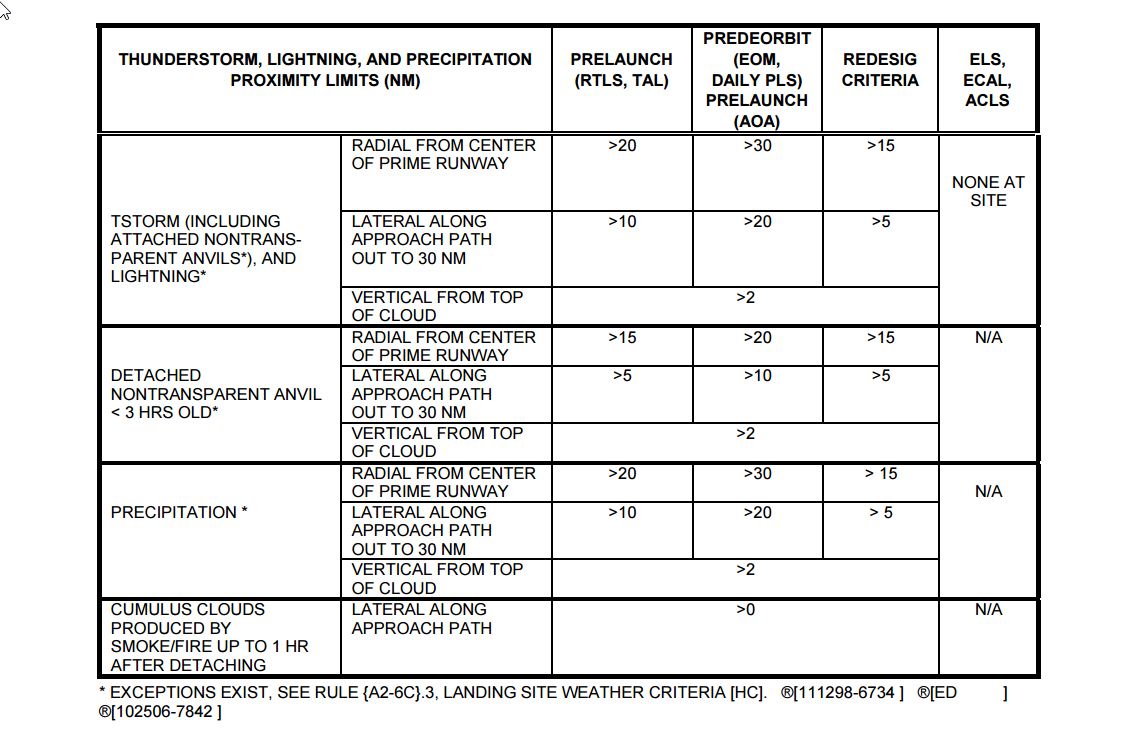
Space Shuttle Flight Rules - Thunderstorms, Lighting, and Precipitation Proximity
Surface Winds and Turbulence
Wind conditions were among the most heavily scrutinized factors in Shuttle landing operations. Unlike conventional aircraft, the Orbiter was an unpowered glider during the final phases of flight. Once committed to landing, there was no possibility of executing a go-around or applying additional thrust to compensate for adverse conditions.
As a result, crosswinds, tailwinds, gusts, and turbulence were monitored closely and often became the determining factor in site selection. A landing site with clear skies and excellent visibility could still be declared "no-go" if forecast winds exceeded allowable limits.
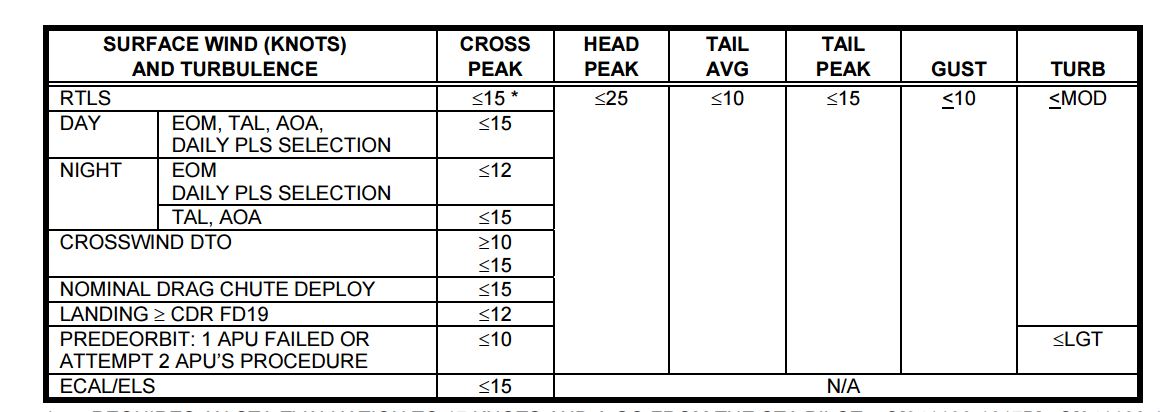
Space Shuttle Flight Rules - Surface Wind and Turbulence Limits
To support these evaluations, FDOs used several specialized analysis tools that incorporated forecast weather information into landing assessments. QuAC (Quick Analysis of Crosswinds) provided rapid calculations of runway-relative headwind, tailwind, and crosswind components based on the forecast wind conditions and planned runway selection. For more detailed evaluations, the Approach and Landing Processor (ALP) simulated the Orbiter's final approach and landing environment, including trajectory performance, lighting conditions, and potential sun-glare impacts on the flight deck windows.
Together, these analyses allowed flight controllers to determine not only whether a site met published weather criteria, but also whether the anticipated landing conditions would support a safe and controllable Orbiter approach. In many cases, wind constraints, not precipitation or cloud cover, proved to be the factor that ultimately removed a landing site from consideration.
Crossrange Constraints
How far can we turn?
Weather and runway conditions determined whether a landing site was operationally acceptable, but vehicle performance ultimately determined whether the Orbiter could reach the site at all. One of the most important measures used by Flight Dynamics Officers during landing site selection was crossrange, the lateral distance between the Orbiter's ground track and the desired landing site.
Crossrange capability varied from mission to mission and depended on numerous factors, including the specific Orbiter being flown, vehicle weight, orbital inclination, altitude, season, atmospheric conditions, and mission objectives. As a result, crossrange limits were calculated individually for each mission and provided to flight controllers through mission planning products and the Deorbit Opportunities Planning System (DOPS).
Dispersed Crossrange Limit
The dispersed crossrange limit represented the maximum acceptable crossrange for a planned Shuttle landing opportunity. This value accounted for realistic operational uncertainties, including navigation errors, atmospheric variations, vehicle energy dispersions, and wind effects. Specifically, it assumed a three-sigma combination of navigation, atmosphere, energy, and wind uncertainties while still allowing the Orbiter to converge to nominal conditions by Terminal Area Energy Management (TAEM) interface at approximately Mach 2.5.
All planned landing opportunities were expected to remain within the dispersed crossrange limit. Landing sites with crossrange values between the dispersed and undispersed limits were considered increasingly risky because the vehicle might not possess sufficient performance margin to absorb the real-world dispersions encountered during entry.
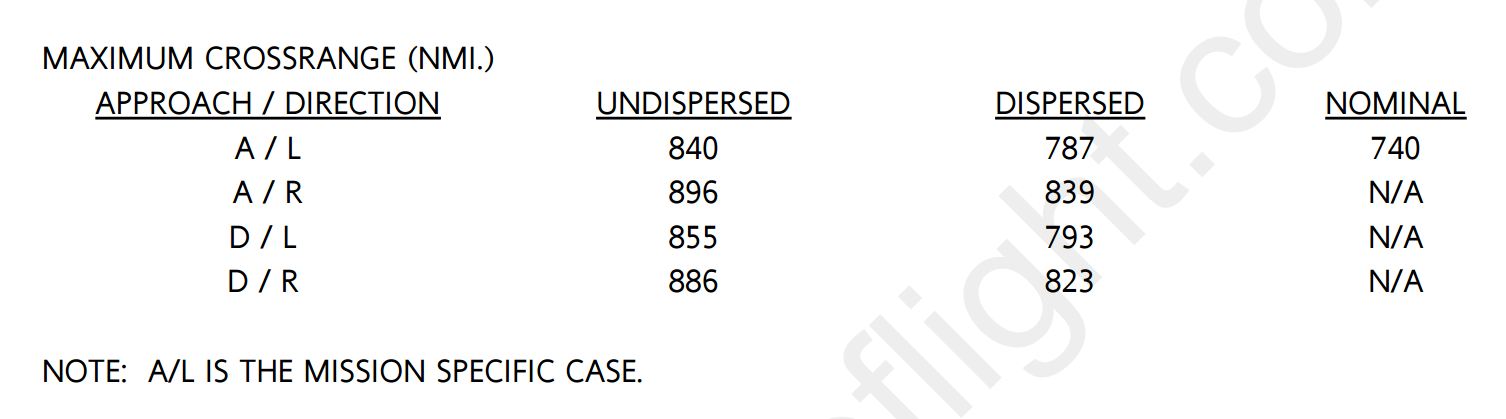
Space Shuttle - sample Groundrules and Constraints for Crosswind Limits
Undispersed Crossrange Limit
The undispersed crossrange limit represented the theoretical maximum capability of the Orbiter. This value assumed perfect onboard navigation, design atmosphere, design winds, nominal vehicle energy, and ideal vehicle response throughout entry.
Landing sites beyond the undispersed limit were considered unreachable. Even under ideal conditions, the Orbiter could not reliably achieve the required trajectory. In practical terms, attempting to deorbit toward a site outside the undispersed limit offered little advantage over a bailout scenario because insufficient vehicle performance existed to reach the runway.
For this reason, DOPS did not generate landing opportunities beyond the undispersed crossrange limit. Such opportunities were considered operationally unachievable and were therefore excluded from planning products provided to flight controllers.
Operational Application
During daily landing site selection, DOPS provided Flight Dynamics Officers with candidate landing opportunities and their associated crossrange values. Under normal circumstances, FDOs selected sites that remained comfortably within the dispersed crossrange limit, ensuring adequate margin for navigation errors, atmospheric variations, winds, and vehicle performance uncertainties.
Opportunities that exceeded the dispersed limit but remained within the undispersed limit were generally avoided and considered only when no better alternatives existed. These cases represented situations where the Orbiter possessed sufficient theoretical capability to reach the site, but with significantly reduced operational margin.
The distinction between dispersed and undispersed crossrange limits served as an important safeguard throughout the Shuttle Program. The question was never simply whether the Orbiter could reach a runway. The question was whether the Orbiter could reach that runway safely while maintaining sufficient margin to accommodate the uncertainties of real-world flight.
Flight Dynamics Reference Collection
The maps used by Mission Control to monitor, evaluate, and support the worldwide landing infrastructure of the Space Shuttle Program.

Worldwide Landing Site Network
This Flight Dynamics Officer reference map shows the full global network of approved Space Shuttle landing sites. From primary runways at Kennedy Space Center and Edwards Air Force Base to contingency locations across Europe, Africa, the Middle East, Asia, Australia, and South America, every site underwent extensive evaluation for runway suitability, weather support, navigation capability, emergency services, and Orbiter recovery logistics.
The map illustrates the remarkable worldwide infrastructure required to support Shuttle missions safely.

East Coast Abort Landing Sites
This Flight Dynamics Officer reference map shows the East Coast Abort Landing sites along the eastern United States. These locations supported possible intact abort scenarios during high-inclination Space Shuttle launches, when the Orbiter’s ground track carried it up the East Coast.
During launch, these sites could be placed on high alert, ready to support an Orbiter landing with very little warning if Mission Control needed to call an abort option in real time.

Transoceanic Abort Landing Network
During ascent, the Space Shuttle's most critical abort options were often located across the Atlantic Ocean. This Flight Dynamics reference map highlights the European and African landing sites that supported TAL abort scenarios.
Locations such as Zaragoza, Morón, Ben Guerir, Istres, and others stood ready to receive an Orbiter experiencing a major propulsion system failure during ascent. These sites represented years of international coordination, military support agreements, weather forecasting, communications planning, and emergency preparedness.
Space Shuttle Landing Metrics
Every Space Shuttle landing, from STS-1 through STS-135, traced its heritage back to a series of flight tests conducted with Enterprise in 1977. Those Approach and Landing Tests validated the Orbiter's aerodynamic performance, flight control software, crew procedures, and runway landing techniques before the first operational mission ever launched.
The reference collections below document both the beginning and the operational legacy of Shuttle landings: the ALT program that proved the concept and the complete historical record of landing sites used throughout the Space Shuttle Program.
Approach and Landing Test
Using Enterprise to prove the system
This table outlines the Space Shuttle Approach and Landing Tests conducted by the orbiter Enterprise. These critical evaluations were designed to assess the shuttle's landing capabilities and systems in preparation for future missions.
| Order | Mission | ALT Test Date | Orbiter | Duration | Landing site | Notes |
|---|---|---|---|---|---|---|
| 1 | ALT-12 | 8/12/1977 | Enterprise | 5 minutes | EDW | First free flight First non-captive flight of Enterprise First landing at Edwards Air Force Base |
| 2 | ALT-13 | 9/13/1977 | Enterprise | 5 minutes | EDW | Second free flight |
| 3 | ALT-14 | 9/23/1977 | Enterprise | 5 minutes | EDW | Third free flight |
| 4 | ALT-15 | 10/12/1977 | Enterprise | 2 minutes | EDW | Fourth free flight First flight without tailcone (operational configuration) |
| 5 | ALT-16 | 10/26/1977 | Enterprise | 2 minutes | EDW | Final free flight Final non-captive flight of Enterprise First landing on runway rather than lakebed |
Space Shuttle Program Landing Site Data
Historical record of every landing
This table provides a comprehensive overview of Space Shuttle missions, detailing key information such as launch and landing times, the specific Space Shuttle Orbiter used, and the designated landing sites. Each mission played a significant role in advancing human space exploration and scientific research. Explore the milestones achieved by these iconic spacecraft throughout their operational history. Please note that landing sites were not listed for Challenger on STS-51L nor for Columbia on STS-107
| Flight Order | Mission Name | Launch date | Landing Date | Orbiter | Landing site |
|---|---|---|---|---|---|
| 1 | STS-1 | 04/12/1981 | 04/14/1981 | Columbia | EDW |
| 2 | STS-2 | 11/12/1981 | 11/14/1981 | Columbia | EDW |
| 3 | STS-3 | 03/22/1982 | 03/30/1982 | Columbia | WSSH |
| 4 | STS-4 | 06/27/1982 | 07/04/1982 | Columbia | EDW |
| 5 | STS-5 | 11/11/1982 | 11/16/1982 | Columbia | EDW |
| 6 | STS-6 | 04/04/1983 | 04/09/1983 | Challenger | EDW |
| 7 | STS-7 | 06/18/1983 | 06/24/1983 | Challenger | EDW |
| 8 | STS-8 | 08/30/1983 | 09/05/1983 | Challenger | EDW |
| 9 | STS-9 | 11/28/1983 | 12/08/1983 | Columbia | EDW |
| 10 | STS-41-B | 02/03/1984 | 02/11/1984 | Challenger | KSC |
| 11 | STS-41-C | 04/06/1984 | 04/13/1984 | Challenger | EDW |
| 12 | STS-41-D | 08/30/1984 | 09/05/1984 | Discovery | EDW |
| 13 | STS-41-G | 10/05/1984 | 10/13/1984 | Challenger | KSC |
| 14 | STS-51-A | 11/08/1984 | 11/16/1984 | Discovery | KSC |
| 15 | STS-51-C | 01/24/1985 | 01/27/1985 | Discovery | KSC |
| 16 | STS-51-D | 04/12/1985 | 04/19/1985 | Discovery | KSC |
| 17 | STS-51-B | 04/29/1985 | 05/06/1985 | Challenger | EDW |
| 18 | STS-51-G | 06/17/1985 | 06/24/1985 | Discovery | EDW |
| 19 | STS-51-F | 07/29/1985 | 08/06/1985 | Challenger | EDW |
| 20 | STS-51-I | 08/27/1985 | 09/03/1985 | Discovery | EDW |
| 21 | STS-51-J | 10/03/1985 | 10/07/1985 | Atlantis | EDW |
| 22 | STS-61-A | 10/30/1985 | 11/06/1985 | Challenger | EDW |
| 23 | STS-61-B | 11/26/1985 | 12/03/1985 | Atlantis | EDW |
| 24 | STS-61-C | 01/12/1986 | 01/18/1986 | Columbia | EDW |
| 25 | STS-51-L | 01/28/1986 | Challenger | ||
| 26 | STS-26 | 09/29/1988 | 10/03/1988 | Discovery | EDW |
| 27 | STS-27 | 12/02/1988 | 12/06/1988 | Atlantis | EDW |
| 28 | STS-29 | 03/13/1989 | 03/18/1989 | Discovery | EDW |
| 29 | STS-30 | 05/04/1989 | 05/08/1989 | Atlantis | EDW |
| 30 | STS-28 | 08/08/1989 | 08/13/1989 | Columbia | EDW |
| 31 | STS-34 | 10/18/1989 | 10/23/1989 | Atlantis | EDW |
| 32 | STS-33 | 11/22/1989 | 11/27/1989 | Discovery | EDW |
| 33 | STS-32 | 01/09/1990 | 01/20/1990 | Columbia | EDW |
| 34 | STS-36 | 02/28/1990 | 03/04/1990 | Atlantis | EDW |
| 35 | STS-31 | 04/24/1990 | 04/29/1990 | Discovery | EDW |
| 36 | STS-41 | 10/06/1990 | 10/10/1990 | Discovery | EDW |
| 37 | STS-38 | 11/15/1990 | 11/20/1990 | Atlantis | KSC |
| 38 | STS-35 | 12/02/1990 | 12/11/1990 | Columbia | EDW |
| 39 | STS-37 | 04/05/1991 | 04/11/1991 | Atlantis | EDW |
| 40 | STS-39 | 04/28/1991 | 05/06/1991 | Discovery | KSC |
| 41 | STS-40 | 06/05/1991 | 06/14/1991 | Columbia | EDW |
| 42 | STS-43 | 08/02/1991 | 08/11/1991 | Atlantis | KSC |
| 43 | STS-48 | 09/12/1991 | 09/18/1991 | Discovery | EDW |
| 44 | STS-44 | 11/24/1991 | 12/01/1991 | Atlantis | EDW |
| 45 | STS-42 | 01/22/1992 | 01/30/1992 | Discovery | EDW |
| 46 | STS-45 | 03/24/1992 | 03/26/1992 | Atlantis | KSC |
| 47 | STS-49 | 05/07/1992 | 05/16/1992 | Endeavour | EDW |
| 48 | STS-50 | 06/25/1992 | 07/09/1992 | Columbia | KSC |
| 49 | STS-46 | 07/31/1992 | 08/08/1992 | Atlantis | KSC |
| 50 | STS-47 | 09/12/1992 | 09/20/1992 | Endeavour | KSC |
| 51 | STS-52 | 10/22/1992 | 11/01/1992 | Columbia | KSC |
| 52 | STS-53 | 12/02/1992 | 12/09/1992 | Discovery | EDW |
| 53 | STS-54 | 01/13/1993 | 01/19/1993 | Endeavour | KSC |
| 54 | STS-56 | 04/08/1993 | 04/17/1993 | Discovery | KSC |
| 55 | STS-55 | 04/26/1993 | 05/06/1993 | Columbia | EDW |
| 56 | STS-57 | 06/21/1993 | 06/21/1993 | Endeavour | KSC |
| 57 | STS-51 | 09/12/1993 | 09/22/1993 | Discovery | KSC |
| 58 | STS-58 | 10/18/1993 | 11/01/1993 | Columbia | EDW |
| 59 | STS-61 | 12/02/1993 | 12/13/1993 | Endeavour | KSC |
| 60 | STS-60 | 02/03/1994 | 02/11/1994 | Discovery | KSC |
| 61 | STS-62 | 03/04/1994 | 03/18/1994 | Columbia | KSC |
| 62 | STS-59 | 04/09/1994 | 04/20/1994 | Endeavour | EDW |
| 63 | STS-65 | 07/08/1994 | 07/23/1994 | Columbia | KSC |
| 64 | STS-64 | 09/09/1994 | 09/20/1994 | Discovery | EDW |
| 65 | STS-68 | 09/30/1994 | 10/11/1994 | Endeavour | EDW |
| 66 | STS-66 | 11/03/1994 | 11/14/1994 | Atlantis | EDW |
| 67 | STS-63 | 02/03/1995 | 02/11/1995 | Discovery | KSC |
| 68 | STS-67 | 03/02/1995 | 03/18/1995 | Endeavour | EDW |
| 69 | STS-71 | 06/27/1995 | 07/07/1995 | Atlantis | KSC |
| 70 | STS-70 | 07/13/1995 | 07/22/1995 | Discovery | KSC |
| 71 | STS-69 | 09/07/1995 | 09/18/1995 | Endeavour | KSC |
| 72 | STS-73 | 10/20/1995 | 11/05/1995 | Columbia | KSC |
| 73 | STS-74 | 11/12/1995 | 11/20/1995 | Atlantis | KSC |
| 74 | STS-72 | 01/11/1996 | 01/20/1996 | Endeavour | KSC |
| 75 | STS-75 | 02/22/1996 | 03/09/1996 | Columbia | KSC |
| 76 | STS-76 | 03/22/1996 | 03/31/1996 | Atlantis | EDW |
| 77 | STS-77 | 05/19/1996 | 05/29/1996 | Endeavour | KSC |
| 78 | STS-78 | 06/20/1996 | 07/07/1996 | Columbia | KSC |
| 79 | STS-79 | 09/16/1996 | 09/26/1996 | Atlantis | KSC |
| 80 | STS-80 | 11/19/1996 | 12/07/1996 | Columbia | KSC |
| 81 | STS-81 | 01/12/1997 | 01/22/1997 | Atlantis | KSC |
| 82 | STS-82 | 02/11/1997 | 02/21/1997 | Discovery | KSC |
| 83 | STS-83 | 04/04/1997 | 04/08/1997 | Columbia | KSC |
| 84 | STS-84 | 05/15/1997 | 05/24/1997 | Atlantis | KSC |
| 85 | STS-94 | 07/01/1997 | 07/17/1997 | Columbia | KSC |
| 86 | STS-85 | 08/07/1997 | 08/19/1997 | Discovery | KSC |
| 87 | STS-86 | 09/25/1997 | 10/06/1997 | Atlantis | KSC |
| 88 | STS-87 | 11/19/1997 | 12/05/1997 | Columbia | KSC |
| 89 | STS-89 | 01/22/1998 | 01/31/1998 | Endeavour | KSC |
| 90 | STS-90 | 04/17/1998 | 05/03/1998 | Columbia | KSC |
| 91 | STS-91 | 06/02/1998 | 06/12/1998 | Discovery | KSC |
| 92 | STS-95 | 10/29/1998 | 11/07/1998 | Discovery | KSC |
| 93 | STS-88 | 12/04/1998 | 12/15/1998 | Endeavour | KSC |
| 94 | STS-96 | 05/27/1999 | 06/06/1999 | Discovery | KSC |
| 95 | STS-93 | 07/23/1999 | 07/27/1999 | Columbia | KSC |
| 96 | STS-103 | 12/19/1999 | 12/27/1999 | Discovery | KSC |
| 97 | STS-99 | 02/11/2000 | 02/22/2000 | Endeavour | KSC |
| 98 | STS-101 | 05/19/2000 | 05/29/2000 | Atlantis | KSC |
| 99 | STS-106 | 09/08/2000 | 09/19/2000 | Atlantis | KSC |
| 100 | STS-92 | 10/11/2000 | 10/24/2000 | Discovery | EDW |
| 101 | STS-97 | 11/30/2000 | 12/11/2000 | Endeavour | KSC |
| 102 | STS-98 | 02/07/2001 | 02/20/2001 | Atlantis | EDW |
| 103 | STS-102 | 03/08/2001 | 03/21/2001 | Discovery | KSC |
| 104 | STS-100 | 04/19/2001 | 05/01/2001 | Endeavour | EDW |
| 105 | STS-104 | 07/12/2001 | 07/25/2001 | Atlantis | KSC |
| 106 | STS-105 | 08/10/2001 | 08/22/2001 | Discovery | KSC |
| 107 | STS-108 | 12/05/2001 | 12/17/2001 | Endeavour | KSC |
| 108 | STS-109 | 03/01/2002 | 03/12/2002 | Columbia | KSC |
| 109 | STS-110 | 04/08/2002 | 04/19/2002 | Atlantis | KSC |
| 110 | STS-111 | 06/05/2002 | 06/19/2002 | Endeavour | EDW |
| 111 | STS-112 | 10/07/2002 | 10/18/2002 | Atlantis | KSC |
| 112 | STS-113 | 11/23/2002 | 12/07/2002 | Endeavour | KSC |
| 113 | STS-107 | 01/16/2003 | Columbia | ||
| 114 | STS-114 | 07/26/2005 | 08/09/2005 | Discovery | EDW |
| 115 | STS-121 | 07/04/2006 | 07/17/2006 | Discovery | KSC |
| 116 | STS-115 | 09/09/2006 | 09/21/2006 | Atlantis | KSC |
| 117 | STS-116 | 12/09/2006 | 12/22/2006 | Discovery | KSC |
| 118 | STS-117 | 06/08/2007 | 06/22/2007 | Atlantis | EDW |
| 119 | STS-118 | 08/08/2007 | 08/21/2007 | Endeavour | KSC |
| 120 | STS-120 | 10/23/2007 | 11/07/2007 | Discovery | KSC |
| 121 | STS-122 | 02/07/2008 | 02/20/2008 | Atlantis | KSC |
| 122 | STS-123 | 03/11/2008 | 03/26/2008 | Endeavour | KSC |
| 123 | STS-124 | 05/31/2008 | 06/14/2008 | Discovery | KSC |
| 124 | STS-126 | 11/14/2008 | 11/30/2008 | Endeavour | EDW |
| 125 | STS-119 | 03/15/2009 | 03/28/2009 | Discovery | KSC |
| 126 | STS-125 | 05/11/2009 | 05/24/2009 | Atlantis | EDW |
| 127 | STS-127 | 07/15/2009 | 07/31/2009 | Endeavour | KSC |
| 128 | STS-128 | 08/28/2009 | 09/11/2009 | Discovery | EDW |
| 129 | STS-129 | 11/16/2009 | 11/27/2009 | Atlantis | KSC |
| 130 | STS-130 | 02/08/2010 | 02/22/2010 | Endeavour | KSC |
| 131 | STS-131 | 04/05/2010 | 04/20/2010 | Discovery | KSC |
| 132 | STS-132 | 05/14/2010 | 05/26/2010 | Atlantis | KSC |
| 133 | STS-133 | 02/24/2011 | 03/09/2011 | Discovery | KSC |
| 134 | STS-134 | 05/16/2011 | 06/01/2011 | Endeavour | KSC |
| 135 | STS-135 | 07/08/2011 | 07/21/2011 | Atlantis | KSC |
Cool!
Hey! This is really great. I found your site from a link on simpleflying.com. Thanks for this info.
When I was stationed at Kadena Air Base Okinawa from 79 to 81 we were designated as a abort destination .
I worked in Central Security Control and we had charts and maps on the wall to advise Security where the shuttle would be parked, perimeter control and access etc.
Hi Chris! Thanks for adding that cool bit of Shuttle history… and yes, there were a number of 12Kft runways around the world that could have been used for those contingency landings.
The sites that I have listed on this page were ones that were actively supported during certain mission timeframes with dedicated personnel. Not every one of the 12Kft runways around the world met that criteria, although we certainly *would* have used (for instance) Kadena if it were our best option – even if we didn’t have real-time personnel there to meet the Orbiter!
I know that at the two trans-Atlantic abort sites for a particular mission there were personnel on standby during launch. I assume that these were local airport workers who were being paid by NASA for this? Or maybe there was also at least one NASA employee stationed there during the launch. Were people on standby at all of the east coast launch abort sites? As for emergency landings from space, since a particular site could be called up anytime during the mission, I would guess that no one was necessarily there on standby during the entire mission dedicated to Shuttle, but that instead all of the controllers and security personnel had been briefed or received training so that whoever happened to be working when the emergency occurred would be able to handle it. That’s my guess anyway. Thanks for any insight on this.
Hi Steve! There were actually several TAL abort sites that could be used, depending on the inclination of the mission. You’re correct, though, that some locals were paid for support, but the primary TAL support were NASA (or DoD) personnel specifically sortied to those sites pre-launch to verify all of the NAVAIDS were working and then to support the actual mission. There would be times where the *specific* TAL site wouldn’t be selected until the final weather forecast briefing, so there were NASA/DoD personnel at multiple sites! For “emergency landings”, a lot of these were “best available support”, but the primary CONUS site (EDW, KSC, or NOR) for specific orbits each day were fully staffed and ready. There were also times where certain worldwide landing sites could be identified as possible options, based on the orbital groundtrack, so in those cases – they had knowledge of a possible timespan in which (if it were to happen) they might have been needed to support. The FDO would coordinate with the Landing Support Officer (DoD early on, but transitioned to NASA personnel who worked directly with DoD and State assets worldwide for coordination) to make sure they always had the latest deorbit opportunities timeline. You can see an example of one of the CONUS Deorbit Opportunities Table on the Entry FDO displays page. But again, yes – anyone who was at a potential emergency landing site (CONUS, TAL, or otherwise) that would have needed to support a Shuttle landing would have received both extensive initial and subsequent refresher training!
Hi I was told that filton air field in Bristol was the back up to RAF Fairfield if the shuttle over shot it’s mark
Hi Joe! RAF Filton, being only 8Kft in length, would never have been a *planned* Shuttle runway. We never planned on anything less than 12Kft as a rule, with Fairford being one of the exceptions (10Kft) because of lack of options. However, if it were a “really bad day” and the energy situation (velocity and altitude, including rates) were so low as to not have any options, it would be any visual option available.
Filton was never a TAL nor abort site. Fairford (FFD on the MOCR map) was routinely put on alert for a launch, even one time during when the Air Tattoo was on the base. A friend who works on the fire team said they were routinely tested on requirements, should they ever be required.
I’m an Air Traffic Controller at Shannon ACC (en route control centre just down the road from Shannon Airport). In the Boardroom at work we have an Irish flag which flew in space aboard Discovery in 2008, presented by NASA as thanks for the unit’s support of the Shuttle program[me]
Hi Neil – that’s a fantastic memento and deserved recognition. Thank you for your and your unit’s support. The Shuttle Program was truly a worldwide team effort!
Comment *Hi Roger. I would very much like to clear something up. There has been a myth for many years here in Zimbabwe that Hwange National Park Airport (HWN)was an emergency landing site for the shuttle. The runway is 15,092 feet and asphalt. Could this have been true as I see that Hoedspruit is listed as one of the African runways? Thank you
Hi James – there are distinctions in Space Shuttle ELS designations that are in play here. While yes – HWN is certainly long enough to support the landing and rollout requirements, there would not have been the Tactical Air Navigation / Navigation Aids (TACAN/NAVAIDS) required to support a safe/planned landing there. HWN isn’t in the Flight Data File (FDF) “Flight Maps and Charts” that I have (vintage 1991), so it would have had to have been a “Very Bad Day ™” to not be able to use one of the more equipped facilities (listed in the FDF) within a possible entry groundtrack. A proper ELS designation required not only the physical dimensions to support but also some of the basic navigation aids and agreements via State Department/DoD channels. I don’t believe HWN ever was in that list.
Hi Roger, firstly apologies for having not replied as this feed just came up on my email a couple of days ago!! And secondly thank you very much for your reply. It is a safari guides ‘myth that perpetually goes around the campfire sice for many years that HWN was a possible landing site. The runway is 4600m / 15,092Kft long with, at the time of extending it, only one commercial flight landing on a twice daily rotation. Hence the myth that one of the longest runways – and most un-used – was an emergency site. But your information certainly helps to clear up the myth! At least on a “Very Bad Day” the field would have been long enough. and weather wise probably ideal due to mostly clear days and average temperature ranges, ie not excessively hot.
Mind you, it would have been an interesting panic at the field to get all of the buffalo, zebra, wildebeest, Topi, baboons and other wildlife off the airfield before a landing..!!
Hi James! No apologies – always great to hear from you! 🙂
Yeah – the thought of guides and tourists frantically “shooing off” wildlife on the runway would’ve been one for the books… or at least a Netflix movie!