
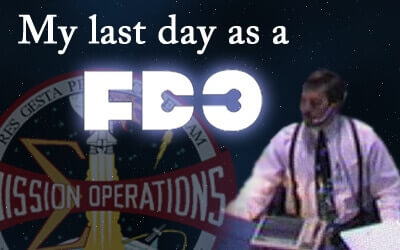
My last day as a Flight Dynamics Officer, on console in the Mission Control Center was bittersweet.
My career with NASA was ending on a high note. I was Lead FDO for the STS-86 mission and the seventh docking between a Space Shuttle and the Russian space station Mir. I had worked every Mir mission to that point, so it was an appropriate way to exit. 🙂
The overall mission had gone without a hitch, as the crew and the team in the MCC had performed their jobs as they had been trained.
On my last day, I had expected the time to pass quickly and quietly, without much in the way of recognition or fanfare.
But... that isn't what happened. (grin)
At the start of my shift, during the traditional hand-over period where the off-going team briefs and prepares the on-coming team, several of my management and some of the other FDOs brought in a cake for us to share with the rest of the MCC team.
It was wonderful, with the FDO logo drawn onto the frosting, with Atomic Fireballs (the FDO console candy of choice!) as decoration!
I was very pleased and surprised by this, but more was to come.

During the handover, each oncoming Flight Control position provides a status briefing to the Flight Director and the rest of the MCC team as to what has happened in the last day since we'd been on console together and what particular things each team was working for the upcoming shift.
After I gave my briefing, Flight Director Phil Engelauf made a nice speech on the Flight Director loop letting everyone know, if they hadn’t heard already, that this was my last flight and, indeed, my last shift! It was unexpected, and I greatly appreciated his sentiments.
STS-86 FLIGHT DIRECTOR LOOP
During the shift, we executed an OMS (Orbital Maneuvering System) Engine firing over a ground observing station in Peru known as Jicamarca. So, I was able to make my last "Flight, FDO... burn complete, no further trim required" call on my last day!
After that burn, I expected the last couple of hours to go by slowly and quietly... kind of "riding into the sunset" mode... 😉
I was wrong...
Commander Jim Wetherbee got my attention when he called down on the Air-to-Ground loop with a "Houston, Atlantis... with a question for FDO..."
Needless to say, that got my attention very quickly!
When he followed it up with a "Is it Roger?" question, I knew something else was up!!!
He proceeded to give me a nice "send off" on the Air-to-Ground loop as well, with some bantering between him and our CAPCOM about the Texas-Oklahoma State football game that was going on and the fact that I was moving on to work at The University of Texas in my immediate post-FDO occupation.
WxBee commented that my "trajectory skills" would be needed on the "field of friendly strife" (football field!), since my beloved 'Horns were getting beaten that day. It was an audio exchange I'll treasure forever.
STS-86 A/G LOOP

It is a tradition, also, at the end of a FDO's last flight, to take one side of the "FDO" sign on top of the console.
In addition to STS-86 being my last flight, it was also the last flight of my good friend, Matt Abbott, who was going to work for the Canadian Space Agency. Matt has since returned to NASA and has enjoyed a successful "second NASA career" as a Flight Director.
Here's a picture of Matt and me, after STS-86 landed, with our halves of the FDO sign from the MCC!
There's 27 years of FDO-related experience between us, with my 12 and Matt's 15 years.
This picture was taken by our friend, and one of the senior Flight Directors, Bob Castle. Thanks, Bob, for this great shot!!!
I have this FDO sign in my office, framed with a great Shuttle-Mir shot that was signed by all of my co-workers and friends when I retired. It's one of my most treasured items from that time.
What a great way to finish a long and enjoyable career as a Space Shuttle Flight Controller...