
Mission Control Culture
The Flight Controller's
CREED
The principles that guide generations of NASA Flight Controllers.
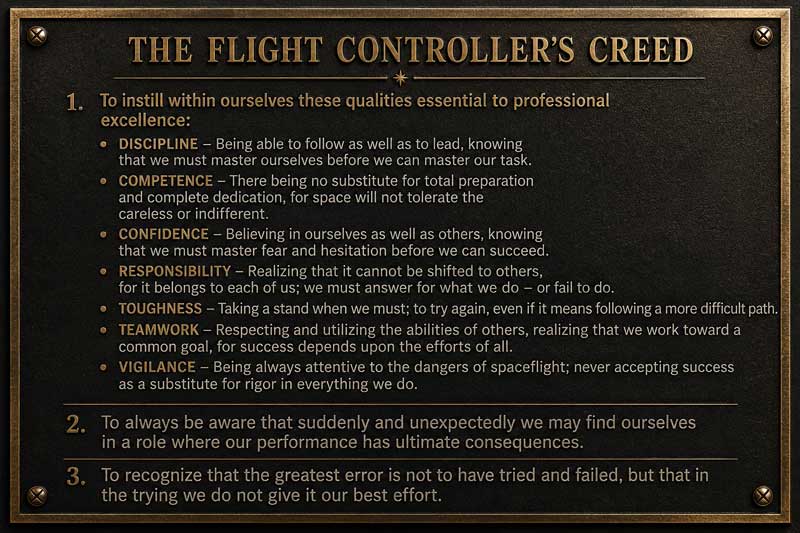
These words hang outside the entrance to Mission Control in Houston. Every Flight Controller certified for console operations is expected to understand them, uphold them, and live by them.

The Origin: Apollo 1
Following the tragic loss of the Apollo 1 crew on January 27, 1967, Flight Director Gene Kranz addressed the Mission Operations team.
He wrote two words on the chalkboard:
TOUGH. COMPETENT.
He explained that from that day forward, Flight Control would be defined by those words. Tough meant never compromising on standards, being accountable for every action, and never rolling the dice hoping for miracles. Competent meant never taking anything for granted and never being found short in skills and knowledge.
The Foundations of Mission Operations
Seven principles that define how we work, howe we think, and who we are.

Discipline
Follow procedures when everything is routine. Follow them even more carefully when everything is not.

Competence
Nobody was expected to know everything. Everyone was expected to be prepared.

Confidence
Speak up when the data says something is wrong, even when the room is full of experts.

Responsibility
Every console position owned its decisions. Excuses did not save missions.

Toughness
The willingness to make difficult calls when easier answers would be more comfortable.

Teamwork
The Flight Control team succeeds together or falls together.

Vigilance
Yesterday's successful mission was never proof that tomorrow would be.

Performance has ultimate consequences
The Creed reminds every Flight Controller that spaceflight does not forgive mistakes. Most days in Mission Control were routine. Some were not.
A missed trend, an incorrect assumption, or a delayed recommendation could place a crew, vehicle, or mission at risk. The purpose of training, simulations, procedures, and certification was to prepare controllers for the moment when their decisions suddenly carried consequences far beyond their console.
That was not intended to create fear. It was intended to create responsibility

Our Best Effort
The final section of the Creed may be its most powerful.
Flight Controllers understood that spaceflight involves risk. Not every problem has a perfect solution. Not every mission unfolds exactly as planned.
The greatest failure is not making an honest attempt and falling short.
The greatest failure if failing to prepare, failing to engage, or failing to give everything possible when the moment demands it.
Mission Control could accept mistakes. It could not accept complacency.
When The Creed was Tested
The true measure of these principles comes when missions, decisions, and lives are on the line.

Apollo 1
January 27, 1967
The loss of the Apollo 1 crew forced Mission Control to confront hard truths about accountability, preparation, and professional responsibility.
Gene Kranz's call to be Tough and Competent became the foundation of the Flight Controller's Creed.

Challenger
January 28, 1986
The Challenger accident reinforced the importance of questioning assumptions, speaking up, and never accepting risk without understanding it.
The Creed's principles of Responsibility, Toughness, and Confidence were tested in the most public way imaginable.

Columbia
February 1, 2003
The Columbia accident reminded NASA that success can never replace vigilance and that even mature programs remain vulnerable to overlooked risks.
Following the accident, Vigilance was added to the Creed as a permanent reminder of that lesson.

A Personal Reflection
When I first read the Creed, I understood the words. Years later, after simulations, missions, launch attempts, and landings, I understood the responsibility behind them. These principles shaped how I worked every day on console.
They are not slogans. They are expectations.
They are not instructions. They are standards.
The Creed wasn't simply something hanging outside a room.
It was how Mission Control expected us to think.
The Creed is what allowed ordinary people to do extraordinary things together.
- Roger Balettie, Flight Dynamics Officer
Related Essays and Stories

30 Years On: LEssons from Challenger
What we learned, what changed, and what still matters today.

We Came Here, You and I...
Remembering those we have lost and promising a bold future of advancement.
The Foundations of Mission Operations
- To instill within ourselves these qualities essential to professional excellence:
- Discipline - Being able to follow as well as to lead, knowing that we must master ourselves before we can master our task.
- Competence - There being no substitute for total preparation and complete dedication, for space will not tolerate the careless or indifferent.
- Confidence - Believing in ourselves as well as others, knowing that we must master fear and hesitation before we can succeed.
- Responsibility - Realizing that it cannot be shifted to others, for it belongs to each of us; we must answer for what we do — or fail to do.
- Toughness - Taking a stand when we must; to try again, even if it means following a more difficult path.
- Teamwork - Respecting and utilizing the abilities of others, realizing that we work toward a common goal, for success depends upon the efforts of all.
- Vigilance - Being always attentive to the dangers of spaceflight; never accepting success as a substitute for rigor in everything we do.
- To always be aware that suddenly and unexpectedly we may find ourselves in a role where our performance has ultimate consequences.
- To recognize that the greatest error is not to have tried and failed, but that in the trying we do not give it our best effort.